Diplomatic Episodes.From Hiroshima & Nagasaki to the START Talks
|
Nitze's Exposure to the Destructive Capabilities of the Atom Bombs
Nitze’s expertise in nuclear weapons originated after the conclusion of World War II. On August 15, 1945, Truman requested an unbiased report of the effectiveness of the air war against Japan, including the August 6th and 9th deployment of the atomic bombs, respectively, in Hiroshima and Nagasaki.[1] Nitze was on this team and therefore saw first-hand the effects of nuclear weapons on the cities, conducted interviews with the survivors, and saw victims of radiation poisoning.[2] This would have a lasting impression on Nitze and contribute to how some colleagues described him with a ‘doomsday’ approach to arms control, but this experience emphasized the importance of safeguarding the U.S. In the study’s report, it described the possibilities of nuclear weapons as, “The capacity to destroy, given control of the air and an adequate supply of atomic bombs, is beyond question.”[3] Overall, Nitze’s post World War II experience in Japan influenced his position and mission to the protection of the American people from nuclear devastation.
NSC-686Following the Soviet's successful nuclear test on August 29, 1949, Truman ordered a review of U.S. foreign policy and possible strategies to combat a now nuclear USSR. Nitze became the director of Policy Planning on January 1, 1950, and therefore in charge of the joint State and Defense department committee to review U.S. national security. As director of the Policy Planning Staff, Nitze’s emphasized the importance of understanding the Soviets, in order to predict their actions. His research in preparation for this report focused on ‘The Kremlin design,’ which was ultimate Soviet world domination, beginning on the Eurasian landmass and with the U.S. as its final target.[4] The USSR committed itself to undermine the U.S. by any means, not just militarily.[5] Because Nitze believed the USSR would undertake actions other than purely military, the NSC-68 argued for ‘total diplomacy’ policy that would extend containment policies in Western Europe and East Asia, increase espionage, and above all increase the defense budget. On April 7, 1950, Nitze presented NSC-68 to the President; however, it was shelved until the outbreak of the Korean war, underscored his pessimistic tone.
|
“In part we relied on United States monopoly of atomic weapons. We knew that our stockpile was small, and many of the military leaders doubted that it could prove decisive if war with the Soviet Union were to occur. But still the atomic bomb was an important weapon which the Soviet Union did not have…Wishful thinking and a tendency to underestimate Soviet capabilities caused some to believe it would last longer than it did.”-Nitze [6] |
Kennedy's Administration
Nitze's Notes During the 1962 Cuban Missile CrisisCourtesy Of Nicolas Thompson [7]
|
Prior to Kennedy’s election, Nitze served as a part of his academic advisory group, and therefore was rewarded with the role of Assistant Secretary for International Security Affairs. During the October 1962 Cuban Missile Crisis, Nitze was a member of ExCOMM, which advised the President in their recommendations to proceed. One of three ‘hawks’, Nitze promoted the air strike strategy against the Cubans, while the Doves favored a less aggressive approach in a naval blockade. [8] Nitze believed that the Soviets would not respond due to U.S. nuclear superiority in the region, but ultimately Kennedy went with the ‘quarantine’ strategy, which was successful. In terms of nuclear security, Nitze states “one of the problems was the degree to which it was possible to achieve a true counterforce capability as opposed to the achievement merely of a secure second strike capability...[Because] “To win a war it would be necessary to have a counterforce capability.” [9] As seen in the beginnings of nuclear arms control with the 1963 Partial Test Ban Treaty, which Nitze supported.
|
Nitze the Nuclear Arms Negotiator:
“I believed in arms control but not disarmament”-Nitze [10]. |
Under LBJ & Understanding ABMs
Nitze became the Secretary of the Navy under LBJ in 1963. Secretary Nitze and Admiral Zumwalt wrote a paper entitled “Considerations Involved in a Separable First-Stage Disarmament Agreement,” containing the points they perceived as vital for arms control negotiations. It outlined the importance of controlling Soviet ICBMs, as they are first-strike capable instruments, and that arms control would only be effective, if they managed to prevent the deployment of anti-ballistic missile (ABM) systems.[11] Pro-ABM lobbyists and LBJ struggled to comprehend the second point as ABMs would enhance U.S. defense from missiles; however, Nitze argued that it actually lowered U.S. defense as it increased an actor’s first-strike capability.
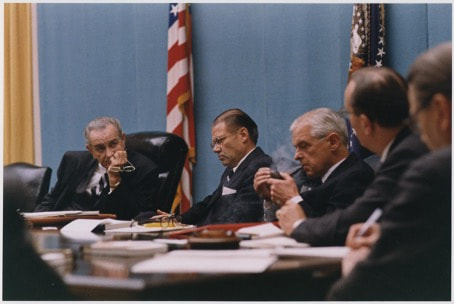
Nitze in NSC Meeting with President LBJ (7/2/1968)
Yoichi Okamoto via Wikimedia
Yoichi Okamoto via Wikimedia
First vs. Second Strike Capability“If an actor has a strong first-strike capability but a weak second-strike capability, it matters who strikes first. But if both sides have low first-strike capability, but strong second-strike capability, there is little to no advantage to instigate a war and is more stable" [12]. |
What is an ABM & How Does it Work?Ballistic Missile Defense via Nuclear Threat Initiative
|
SALT IUnder Nixon, Nitze continued his work in securing an ABM agreement and became a defense representative in the first SALT delegation. Nitze planned to constrain the Soviets ICBMs in exchange for the constraint of U.S. ABMs, because both increased one’s first-strike capacity. Nitze spent two and a half years in negotiations, travelling between Helsinki and Vienna; however, at the pinnacle event of the Nixon-Brezhnev summit, the SALT planners were essentially side-lined. [13] This cause great resentment in Nitze and he resigned prior to the SALT II talks began.
|
SALT IIAfter the Nitze's perceived slight from SALT I, Nitze became a harsh critic of SALT II. On July 12, 1979, Nitze appeared before the Senate Foreign relations committee where he harshly criticized SALT II and claimed that it was less favorable to the U.S., because the limits where so high it would be ineffective. [14] He also utilized a variety of platforms to lobby against the administration's choices. He participated in the 'Team B's critic of Soviet capabilities. In March 1979, Nitze also co-founded the Committee on the Present Danger, whose membership included Ronald Reagan.
|
Reagan: INF, SDI, & START
Reagan appointed Nitze in September 1981, as the chief negotiator for the Intermediate-Range Nuclear Forces (INF) Treaty. Negotiations fell apart, although not for a lack of trying on Nitze’s end. He could not get the U.S. to agree to anything other than Richard Perle’s ‘zero-zero’ solution, which the Soviets would not accept.[15] Despite Nitze’s failure to get an INF agreement, he was made the Special Advisor to the President and Secretary of State on Arms control. Nitze’s next challenge in the Reagan administration was to utilize Reagan’s Strategic Defense Initiative (SDI) to facilitate negotiations for the Strategic Arms Reduction Treaty (START). The main issue with SDI is that it acted essentially as an ABM and thus, if successful, it would give the U.S. a first-strike advantage over the USSR. Therefore, Nitze planned to trade the cancellation of the SDI program for the Soviet dismantlement of their SS-20s in Europe; however, Reagan refused to give up his fantasy and talks fell apart.[16]
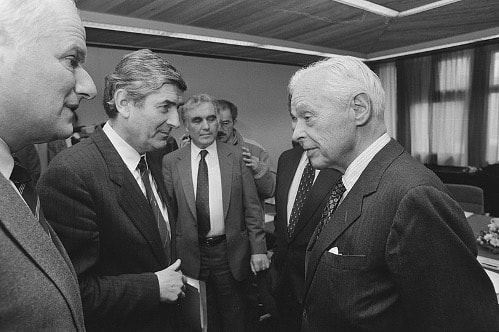
Nitze discussing SDI at the Hague (26/2/1987) via Rob Bogaerts and the Nationaal Archief
Footnotes:
[1] United States Strategic Bombing Survey, Summary Report (Pacific War), (Washington, D.C., 1 July 1946), [HaitiTrust], 17.
[2] United States Strategic Bombing Survey, Summary Report (Pacific War), 22.
[3] United States Strategic Bombing Survey, Summary Report (Pacific War, 29.
[4] Fletcher, “The Collapse of the Western World: Acheson, Nitze, and the NSC 68/Rearmament Decision,” 768.
[5] Paul Nitze, “Recent Soviet Moves”, in Foreign Relations of the United States, 1950, National Security Affairs; Foreign Economic Policy, Volume I, (February 8, 1950), [FRUS].
[6] Paul H. Nitze, “U.S. Foreign Policy: 1945-1955,” Foreign Policy Association, March-April 1956, 29.
[7] Nicolas Thompson. “We Will All Fry,” The New Yorker, October 15, 2012.
[8] George Herring, From Colony to Superpower: U.S. Foreign Relations since 1776, 721.
[9] “Interview with Secretary of the Navy Nitze by Alfred Goldberg” RAND Corporation, NSA Archives, June 15, 1966.
[10] Strobe Talbott, The Master of the Game: Paul Nitze and the Nuclear Peace, (New York: Knopf, 1988), [HathiTrust], 70.
[11] Talbott, The Master of the Game: Paul Nitze and the Nuclear Peace, 96.
[12] Talbott, The Master of the Game: Paul Nitze and the Nuclear Peace, 74-75.
[13] Talbott, The Master of the Game: Paul Nitze and the Nuclear Peace, 133.
[14] Talbott, The Master of the Game: Paul Nitze and the Nuclear Peace, 157-158.
[15] David Callahan, Dangerous Capabilities: Paul Nitze and the Cold War, (New York: HarperCollins, 1991), [HathiTrust Digital Library],433-437.
[16] Callahan, Dangerous Capabilities: Paul Nitze and the Cold War, 464,478.
[2] United States Strategic Bombing Survey, Summary Report (Pacific War), 22.
[3] United States Strategic Bombing Survey, Summary Report (Pacific War, 29.
[4] Fletcher, “The Collapse of the Western World: Acheson, Nitze, and the NSC 68/Rearmament Decision,” 768.
[5] Paul Nitze, “Recent Soviet Moves”, in Foreign Relations of the United States, 1950, National Security Affairs; Foreign Economic Policy, Volume I, (February 8, 1950), [FRUS].
[6] Paul H. Nitze, “U.S. Foreign Policy: 1945-1955,” Foreign Policy Association, March-April 1956, 29.
[7] Nicolas Thompson. “We Will All Fry,” The New Yorker, October 15, 2012.
[8] George Herring, From Colony to Superpower: U.S. Foreign Relations since 1776, 721.
[9] “Interview with Secretary of the Navy Nitze by Alfred Goldberg” RAND Corporation, NSA Archives, June 15, 1966.
[10] Strobe Talbott, The Master of the Game: Paul Nitze and the Nuclear Peace, (New York: Knopf, 1988), [HathiTrust], 70.
[11] Talbott, The Master of the Game: Paul Nitze and the Nuclear Peace, 96.
[12] Talbott, The Master of the Game: Paul Nitze and the Nuclear Peace, 74-75.
[13] Talbott, The Master of the Game: Paul Nitze and the Nuclear Peace, 133.
[14] Talbott, The Master of the Game: Paul Nitze and the Nuclear Peace, 157-158.
[15] David Callahan, Dangerous Capabilities: Paul Nitze and the Cold War, (New York: HarperCollins, 1991), [HathiTrust Digital Library],433-437.
[16] Callahan, Dangerous Capabilities: Paul Nitze and the Cold War, 464,478.
